The Difference Between Wi-Fi and Mobile Data Explained
Most people use the internet every day without giving much thought to how their devices actually connect. Whether you’re streaming videos, scrolling through social media, sending messages, or joining a video call, your phone is usually connected through either Wi-Fi or mobile data.
While both options provide internet access, they work in very different ways. Understanding the difference can help you manage data usage, improve connection speeds, avoid unnecessary charges, and make better decisions about when to use each one.
For many smartphone users, knowing how these connections work can also help solve common issues related to performance, coverage, and battery life.
Key Takeaways
• Wi-Fi and mobile data both provide internet access but use different networks.
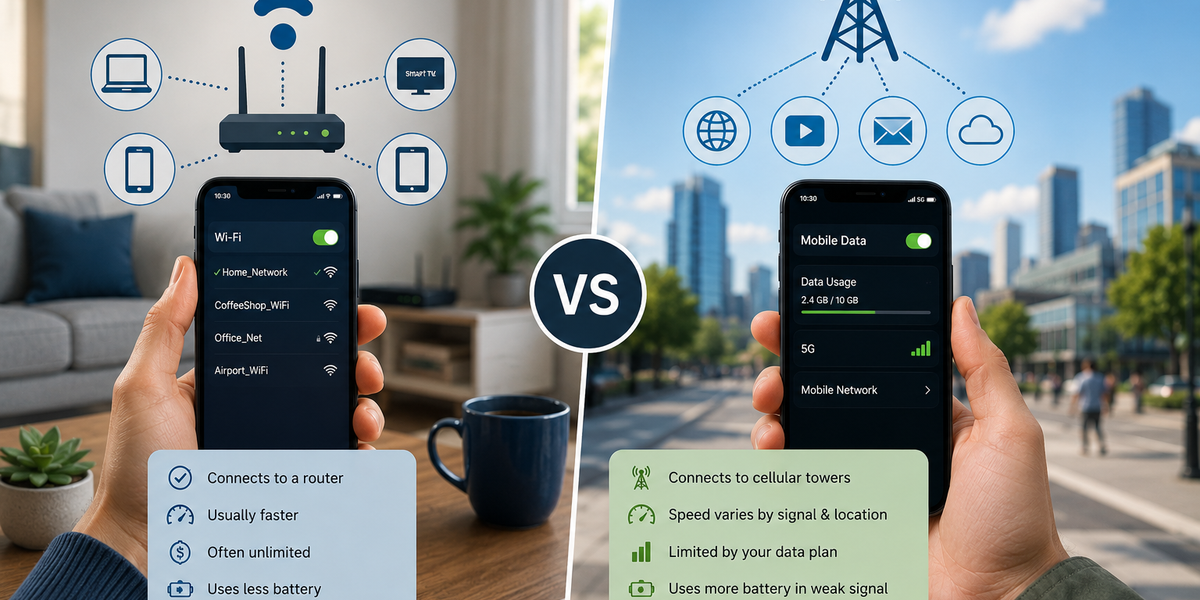
• Wi-Fi connects through a router, while mobile data connects through a cellular network.
• Wi-Fi is often faster and more cost-effective for heavy internet use.
• Mobile data allows internet access when you’re away from Wi-Fi networks.
• Choosing the right connection can improve speed, reliability, and data management.
What Is Wi-Fi?
Wi-Fi is a wireless technology that allows devices to connect to the internet through a router.
The router receives an internet connection from an internet service provider and then broadcasts that connection wirelessly to nearby devices such as phones, laptops, tablets, and smart TVs.
When you’re connected to Wi-Fi at home, in a coffee shop, at school, or in an office, your device is using a local wireless network rather than the cellular network provided by your mobile carrier.
Because Wi-Fi is typically linked to a fixed internet connection, it often supports larger amounts of data usage without additional charges.
What Is Mobile Data?
Mobile data allows devices to connect to the internet using cellular towers operated by a mobile network provider.
Instead of relying on a nearby router, your phone communicates directly with the carrier’s network. This allows internet access in many places where Wi-Fi is unavailable, making mobile data particularly useful while traveling, commuting, or spending time outdoors.
Modern cellular technologies such as 4G and 5G can provide impressive speeds, allowing users to stream videos, browse websites, and use apps almost anywhere with network coverage.
The biggest advantage of mobile data is flexibility. As long as a cellular signal is available, internet access can usually be maintained.
Which One Is Faster?
The answer depends on several factors.
In many situations, a strong home or office Wi-Fi network can provide faster and more stable performance than mobile data. However, a high-speed 5G connection may outperform some public or older Wi-Fi networks.
Speed can be influenced by network congestion, signal strength, distance from the router or cellular tower, and the quality of the internet service itself.
Rather than assuming one option is always faster, it is often more accurate to think of performance as depending on the specific network being used.
Which One Uses More Battery?
Battery consumption can vary depending on signal strength and network conditions.
When a phone struggles to maintain a weak cellular signal, it may use additional power trying to stay connected. Similarly, weak Wi-Fi signals can also increase battery usage.
In many everyday situations, Wi-Fi tends to be slightly more energy-efficient, particularly when connected to a strong and stable network. However, the difference is often small enough that users may not notice it during normal use.
Connection quality often has a greater impact on battery life than the connection type itself.
Understanding Data Limits
One of the biggest practical differences between Wi-Fi and mobile data involves usage limits.
Most home internet plans offer large amounts of data or even unlimited access, allowing users to stream videos, download files, and use online services without worrying about monthly limits.
Mobile data plans, on the other hand, may include usage caps, reduced speeds after certain thresholds, or additional charges for excessive usage.
This is why many people prefer Wi-Fi for activities that consume large amounts of data, such as downloading games, watching high-definition videos, or backing up photos.
When Should You Use Wi-Fi?
Wi-Fi is often the preferred choice when a reliable network is available.
At home, work, or school, Wi-Fi can provide a stable connection while reducing reliance on mobile data. It is particularly useful for data-heavy activities that might otherwise consume large portions of a cellular plan.
Many devices also perform automatic updates and cloud backups more efficiently when connected to Wi-Fi.
Whenever a trusted network is available, Wi-Fi is often the most economical option.
When Should You Use Mobile Data?
Mobile data becomes essential when Wi-Fi is unavailable or unreliable.
Travelers, commuters, and people who spend significant time away from fixed networks rely heavily on mobile data to stay connected. It allows access to navigation apps, messaging services, email, social media, and countless other online tools regardless of location.
The convenience of mobile data is one of the main reasons smartphones have become such powerful everyday devices.
Internet access is no longer tied to a specific place.
Choosing the Right Connection
Wi-Fi and mobile data serve the same purpose, but they excel in different situations.
Wi-Fi is often ideal for heavy internet usage, streaming, downloads, and everyday use at home or work. Mobile data offers flexibility and mobility, keeping users connected wherever cellular coverage exists.
Rather than viewing them as competing technologies, it’s more useful to think of them as complementary tools. Most smartphones automatically switch between the two throughout the day, depending on availability and connection quality.
Understanding the strengths of each can help you stay more efficiently connected, avoid unnecessary data usage, and get the best possible experience from your devices.
In the end, both Wi-Fi and mobile data are designed to accomplish the same goal: keeping you connected to the digital world whenever and wherever you need it.