The Difference Between Stocks, Bonds, and Index Funds
For anyone new to investing, the financial world can seem full of confusing terms and complicated choices. Among the most common investment options are stocks, bonds, and index funds. While these terms are often mentioned together, they represent very different ways of investing money.
Understanding the differences between them is important because each comes with its own level of risk, potential return, and role within an investment portfolio.
There is no single option that is best for everyone. The right choice depends on an individual’s financial goals, time horizon, and tolerance for risk. Learning the basics can help investors make more informed decisions and feel more confident about where their money is going.
Key Takeaways
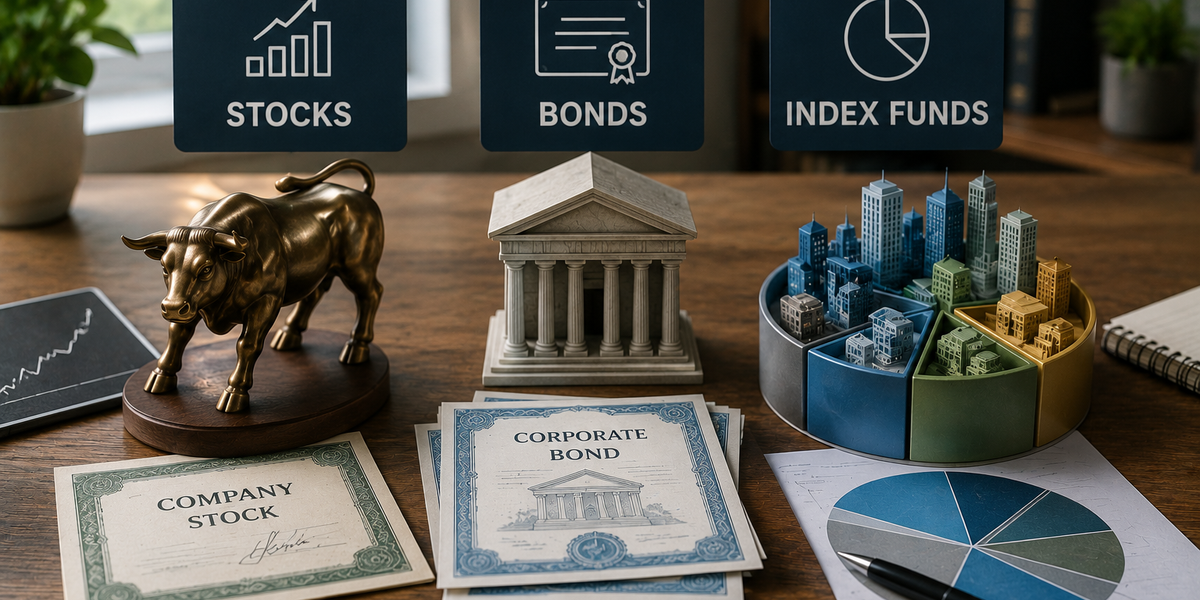
• Stocks represent ownership in a company.
• Bonds are essentially loans made to governments or organizations.
• Index funds are collections of many investments bundled into a single fund.
• Stocks typically offer higher growth potential but greater risk.
• Bonds are generally considered more stable but often provide lower returns.
• Index funds offer diversification and are popular among long-term investors.
What Are Stocks?
When you buy a stock, you are purchasing a small ownership stake in a company.
If the company performs well and grows over time, the value of its stock may increase. Some companies also distribute a portion of their profits to shareholders through payments known as dividends.
Because stock prices can rise and fall based on company performance, economic conditions, and investor sentiment, stocks are often considered one of the riskier investment options. However, they have historically provided some of the highest long-term returns.
For many investors, stocks are an important tool for building wealth over time.
What Are Bonds?
Bonds work differently from stocks.
Instead of buying ownership in a company, you are effectively lending money to a government, corporation, or other organization. In return, the issuer agrees to pay interest over a specified period and eventually repay the original amount borrowed.
Because bond payments are generally more predictable, bonds are often viewed as less risky than stocks. They tend to experience smaller price fluctuations and can provide a steady source of income.
However, lower risk often comes with lower potential returns, especially when compared to stocks over long periods.
Many investors use bonds to add stability to their portfolios.
What Are Index Funds?
An index fund is a type of investment fund that holds a large collection of stocks, bonds, or other assets.
Rather than trying to select individual investments, index funds are designed to track the performance of a specific market index. This means investors gain exposure to many companies or securities through a single investment.
For example, an index fund tracking a major stock market index may hold shares in hundreds of different companies. If some companies perform poorly, stronger performers can help balance the overall results.
This diversification is one reason index funds have become extremely popular among long-term investors.
Understanding Risk and Return
One of the biggest differences between stocks, bonds, and index funds is the balance between risk and potential reward.
Individual stocks often offer the highest growth potential, but they can also experience significant volatility. A company’s value can rise dramatically, but it can also decline unexpectedly.
Bonds generally provide more stability and predictable returns, making them attractive to investors seeking lower risk.
Index funds typically fall somewhere in between. Because they spread investments across many assets, they reduce the risk associated with relying on a single company or security.
Each investment type involves trade-offs between growth, stability, and risk.
Why Diversification Matters
One of the most important principles in investing is diversification.
Rather than placing all of your money into a single stock or asset, diversification spreads risk across multiple investments. This can help reduce the impact of poor performance from any one investment.
Index funds are often praised because they make diversification simple. With a single purchase, investors can gain exposure to dozens or even hundreds of different companies.
Many financial experts consider diversification one of the most effective ways to manage investment risk over the long term.
Which Option Is Right for You?
The answer depends on your financial goals and personal circumstances.
Investors seeking higher long-term growth may allocate a larger portion of their portfolios to stocks. Those who prioritize stability and income may prefer a greater emphasis on bonds.
Many people choose a combination of both through index funds or diversified portfolios. This allows them to pursue growth while also managing risk.
Investment decisions are rarely one-size-fits-all, which is why understanding these options is so important.
Common Misconceptions
One common misconception is that stocks are always better because they have higher growth potential. While stocks have historically delivered strong returns, they also involve greater uncertainty and short-term fluctuations.
Another misconception is that bonds are completely risk-free. Although they are generally considered safer than stocks, bond values can still change, and issuers can sometimes face financial difficulties.
Some people also assume index funds eliminate risk entirely. In reality, they reduce certain risks through diversification, but they remain subject to broader market movements.
Understanding both the benefits and limitations of each investment type leads to better decision-making.
Building a Strong Investment Foundation
Stocks, bonds, and index funds each play a unique role in the investment world. Stocks offer ownership and growth potential, bonds provide stability and income, and index funds allow investors to diversify across many assets with a single investment.
Rather than viewing them as competing options, many successful investors use a combination of all three to build balanced portfolios that align with their goals.
The most important step is not finding the perfect investment. It’s understanding how different investments work and choosing a strategy that fits your long-term financial objectives.
For most investors, knowledge is one of the most valuable investments they can make.