How to Pay Off Debt Faster: The Snowball vs. Avalanche Method
For many people, paying off debt can feel overwhelming. Whether it’s credit card balances, personal loans, student debt, or other financial obligations, watching multiple payments leave your account every month can be frustrating and stressful.
The good news is that paying off debt isn’t just about making larger payments. Having a clear strategy can make a significant difference in how quickly you become debt-free.
Two of the most popular debt repayment strategies are the Snowball Method and the Avalanche Method. Both approaches can help eliminate debt faster than simply making minimum payments, but they work in very different ways.
Understanding the strengths of each method can help you choose the approach that best fits your financial situation and personality.
Key Takeaways
• The Snowball Method focuses on paying off the smallest debts first.
• The Avalanche Method focuses on paying off debts with the highest interest rates first.
• Both strategies require making minimum payments on all debts while directing extra money toward one target debt.
• The Snowball Method can provide faster psychological wins.
• The Avalanche Method typically saves more money on interest over time.
Why a Debt Repayment Strategy Matters
Many people approach debt by making payments wherever they can without a structured plan. While this may reduce balances gradually, it often slows progress and makes it harder to stay motivated.
A debt repayment strategy creates focus. Instead of spreading extra money across multiple balances, you concentrate your efforts on one debt at a time while continuing to make minimum payments on the others.
As each debt is eliminated, the money previously used for those payments becomes available to attack the next balance. Over time, this creates momentum and accelerates the repayment process.
What Is the Snowball Method?
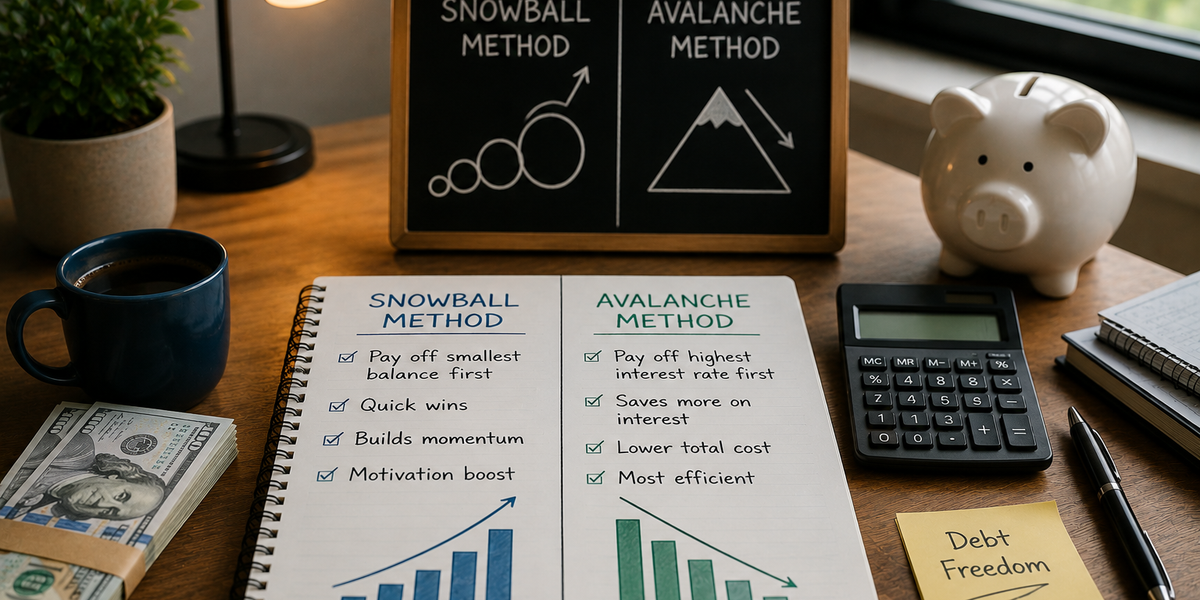
The Snowball Method focuses on paying off debts from the smallest balance to the largest, regardless of interest rates.
After making minimum payments on all debts, any extra money goes toward the smallest balance. Once that debt is completely paid off, the amount that was being used for its payment is added to the next-smallest debt.
This process continues until all debts are eliminated.
The main advantage of the Snowball Method is motivation. Because smaller balances are often paid off relatively quickly, borrowers experience early wins that help them stay committed to the plan.
For many people, those small victories create the momentum needed to keep going.
Why the Snowball Method Works
Debt is not always a mathematical problem. Often, it’s an emotional one.
People can become discouraged when they spend months making payments without seeing any debts disappear. The Snowball Method addresses this by creating visible progress early in the journey.
Each paid-off balance represents a milestone and a reminder that the plan is working.
This psychological boost can be incredibly powerful, especially for individuals who have struggled with debt for a long time.
What Is the Avalanche Method?
The Avalanche Method takes a different approach. Instead of targeting the smallest balance, it prioritizes the debt with the highest interest rate.
After making minimum payments on all debts, any extra money goes toward the balance costing the most in interest. Once that debt is eliminated, attention shifts to the debt with the next-highest interest rate.
This process continues until all balances have been paid off.
Because high-interest debt is addressed first, the Avalanche Method generally reduces the total amount of interest paid over time.
Why the Avalanche Method Works
From a purely financial perspective, the Avalanche Method is usually the most efficient approach.
By eliminating high-interest balances first, borrowers reduce the amount of money lost to interest charges. This often results in faster overall repayment and lower total borrowing costs.
For people who are highly motivated by numbers and long-term savings, the Avalanche Method can be extremely appealing.
The challenge is that the first debt eliminated may not be the smallest one, which means visible progress can sometimes take longer to appear.
Which Method Is Better?
The answer depends on the individual.
If staying motivated is your biggest challenge, the Snowball Method may be the better choice. The quick wins can provide encouragement and help maintain momentum throughout the repayment journey.
If your primary goal is minimizing interest costs and paying off debt as efficiently as possible, the Avalanche Method often has the advantage.
Both strategies are effective because they encourage focused, intentional debt repayment rather than simply making minimum payments indefinitely.
The most successful method is usually the one you can consistently follow.
Common Mistakes to Avoid
Regardless of which strategy you choose, certain mistakes can slow your progress.
One common mistake is continuing to accumulate new debt while trying to pay off existing balances. This can make it difficult to gain momentum and may undo much of the progress being made.
Another mistake is abandoning the plan too quickly. Debt repayment often takes time, and meaningful results rarely happen overnight.
Consistency is often more important than perfection.
Building Momentum Toward Financial Freedom
Paying off debt can feel like a long journey, but every payment moves you closer to financial freedom.
Both the Snowball and Avalanche methods provide clear roadmaps for making progress. One emphasizes motivation and momentum, while the other focuses on efficiency and minimizing interest costs.
Neither approach is universally better. What matters most is choosing a strategy, committing to it, and continuing to move forward.
Debt rarely disappears on its own, but with a clear plan and consistent effort, even large balances can be reduced one payment at a time. The sooner you start, the sooner you can redirect your money toward future goals instead of past obligations.