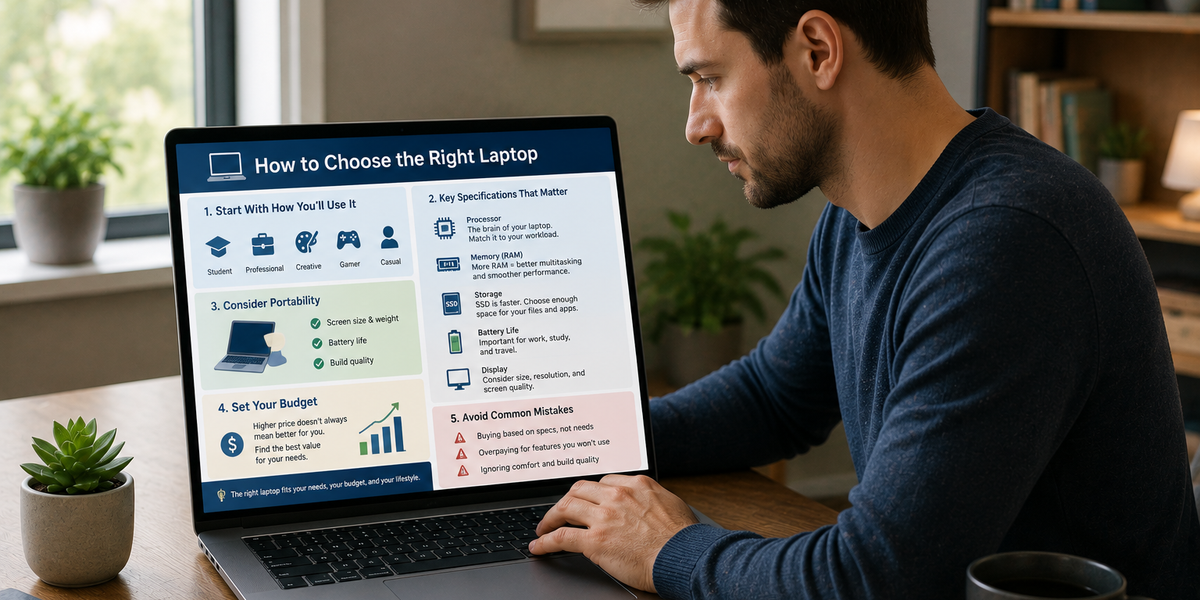
How to Choose the Right Laptop for Your Needs
Buying a new laptop can feel overwhelming. With hundreds of models available and endless specifications to compare, it’s easy to get lost in technical details and marketing claims.
Many people assume they need the most powerful or expensive laptop available, but that’s not always true. The best laptop is not necessarily the one with the highest specifications. It’s the one that fits your specific needs, budget, and daily routine.
Whether you’re a student, remote worker, creative professional, gamer, or casual user, understanding what actually matters can help you make a smarter purchase and avoid spending money on features you’ll never use.
Key Takeaways
• The best laptop depends on how you plan to use it.
• Processor, memory, battery life, and storage are often more important than flashy features.
• Students, professionals, gamers, and creatives typically have different requirements.
• A higher price does not always mean a better fit for your needs.
• Understanding your priorities can save money and prevent buyer’s remorse.
Start With How You’ll Use It
Before comparing brands or specifications, think about what you’ll actually do with your laptop on a daily basis.
Someone who primarily uses email, web browsers, video streaming, and office applications has very different needs than a video editor or software developer. Likewise, a college student may prioritize portability and battery life, while a gamer may care more about graphics performance.
The clearer you are about your typical usage, the easier it becomes to narrow down your options.
A laptop should fit your lifestyle, not the other way around.
Understanding the Processor
The processor is often described as the brain of a laptop because it handles many of the tasks that keep the system running smoothly.
For basic activities such as browsing the internet, watching videos, and working with documents, most modern processors are more than capable. Users who regularly edit videos, work with large datasets, create 3D designs, or run demanding software may benefit from more powerful options.
While processor specifications can seem intimidating, most people do not need the highest-end model available. Choosing a processor that matches your actual workload is usually the smarter decision.
How Much Memory Do You Need?
Memory, commonly known as RAM, affects how well a laptop handles multiple tasks at once.
If you frequently switch between dozens of browser tabs, video calls, documents, and applications, additional memory can help keep everything running smoothly. Limited memory can cause slowdowns, especially when multitasking.
For many users, a moderate amount of RAM is sufficient for everyday work, while professionals handling more demanding tasks may benefit from larger amounts.
A laptop’s performance often depends just as much on memory as it does on processing power.
Storage Matters More Than You Think
Storage determines how many files, photos, videos, applications, and documents your laptop can hold.
People who primarily use cloud storage may not need large amounts of local storage, while photographers, video editors, and content creators often require significantly more space.
Modern laptops typically use solid-state drives, which are faster and more reliable than older storage technologies. Faster storage can make a laptop feel more responsive, reducing loading times and improving the overall user experience.
For many buyers, storage speed is just as important as storage capacity.
Don’t Overlook Battery Life
Battery life is one of the most important features for people who frequently work away from a desk.
A laptop with impressive performance may become frustrating if it constantly requires charging. Students, travelers, and remote workers often benefit from prioritizing battery life alongside performance.
Manufacturer estimates can be useful, but real-world battery performance often varies depending on how the laptop is used.
Considering your daily routine can help determine how important battery life should be in your decision.
Screen Size and Portability
Laptop screens come in a variety of sizes, each with advantages and disadvantages.
Smaller laptops are generally lighter and easier to carry, making them popular among students and frequent travelers. Larger screens provide more workspace and can be more comfortable for extended periods of work, entertainment, or creative projects.
There is no universally perfect size. The right choice depends on whether portability or screen space matters more to you.
Many buyers only realize the importance of this trade-off after using the laptop for several months.
Consider Your Budget Carefully
It’s easy to assume that spending more guarantees a better experience, but that is not always the case.
Many premium laptops include features that certain users may never fully utilize. Paying for advanced graphics, ultra-high-resolution displays, or professional-grade hardware may not make sense if your needs are relatively basic.
Instead of focusing on the most expensive model available, focus on finding the laptop that delivers the best balance of performance, reliability, and value within your budget.
A well-chosen mid-range laptop can often outperform a poorly chosen premium one when it comes to meeting your actual needs.
Common Buying Mistakes
One of the most common mistakes is purchasing a laptop based solely on specifications without considering real-world usage.
Another mistake is buying a machine that’s far more powerful than necessary. While future-proofing can be useful, paying significantly more for features you rarely use may not be the best investment.
Many buyers also underestimate the importance of comfort factors such as keyboard quality, screen brightness, battery life, and overall portability.
A laptop’s daily experience often matters more than its technical specifications.
Finding the Right Fit
Choosing a laptop is ultimately about matching technology to your lifestyle.
The right laptop for a student may be completely different from the right laptop for a designer, programmer, business owner, or casual user. By focusing on how you’ll actually use the device, you can avoid unnecessary expenses and make a decision with confidence.
The goal is not to find the most powerful laptop on the market. It’s to find the one that helps you work, create, learn, and stay connected in the way that suits you best.
A good laptop isn’t defined by its specifications alone. It’s defined by how well it fits the person using it.